


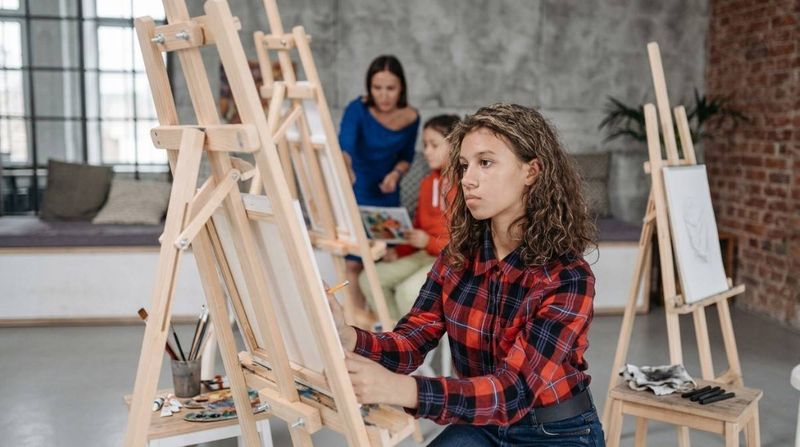
The paper has been out for ten minutes. Most of the class are already working, some of them badly, which is fine. And there is one student sitting with a pencil in hand and nothing on the page.
Ask what's wrong, and you usually get one of these:
- "I don't know what to make."
- "Mine won't look good."
- "Can you just show me how to do it?"
- "What if I do it wrong?"
It is easy to read that as a lack of imagination or as a student who has decided art isn't their thing. Most of the time it isn't either. The student often has plenty of ideas. What they don't have is any confidence that their idea will survive contact with the paper.
That is a different problem, and it needs a different response.
Why do some students freeze up in art class?
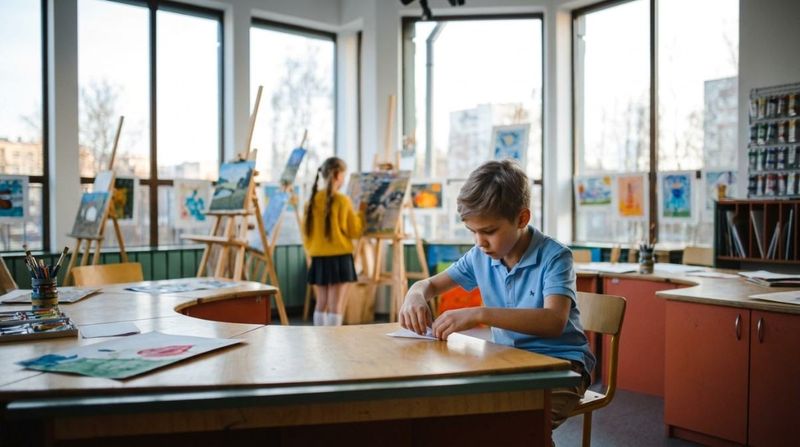
There is rarely one reason. Here are the ones that show up most often in a classroom.
Fear of making a mistake
Younger students in particular believe a drawing is fragile. One bad line and the whole thing is ruined. If you have watched a child crumple a page over a single wobbly curve, you have seen this in action. They are not being dramatic. In their head, the artwork had a correct version, and they have just lost it.
So they wait. Waiting feels safer than ruining something.
Fear of being judged
Art is unusually public for a school subject. Nobody can see your half-finished math working from across the room, but everyone can see your drawing. Students compare, and they compare fast. A student who has already decided that the girl two desks over is "the one who can draw" may quietly stop trying in front of her.
Perfectionism
This one hides well because it often looks like effort. The student erases constantly. They spend twenty minutes on an eyebrow. They want the first attempt to arrive finished, and when it doesn't, they read that as proof they are bad at this rather than proof that first attempts are first attempts.
Too many choices
"Draw anything you want" sounds generous. For some students it is the hardest instruction in the room. Infinite options means no obvious place to begin and no way to tell whether the thing they picked was a good choice. Constraint helps more people than it limits.
Something that happened earlier
Somebody told them they were not good at art. A sibling, a relative, a teacher, a classmate in Year 3. Children hold onto that sort of comment for years, and it tends to surface as avoidance rather than as a complaint. They will not say "someone said my drawing was ugly." They will say they are bored, or they will go to the bathroom for a long time.
Is it anxiety, perfectionism, or fear of getting it wrong?
Honestly, these overlap so much that separating them is mostly an academic exercise. Still, it helps to know what you are looking at.
Perfectionism tends to look like erasing, restarting, refusing to begin, asking "Is this good?" every few minutes, and finishing the task while looking miserable about it.
Fear of judgment looks different. Those students copy their neighbor, pick the safest possible idea, avoid anything unusual, and ask whether their approach is allowed. They are not trying to make something good so much as trying to avoid making something wrong.
You are not diagnosing anyone. Teachers are not meant to, and a label doesn't help the student start. What helps is noticing which pressure is in the way, then removing some of it.
The blank page problem
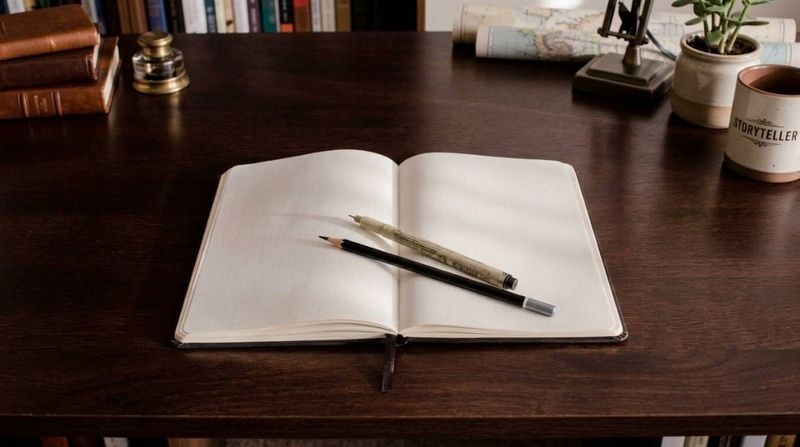
A blank page offers no clue about what should happen next. There is no starting point, no partial structure, and no indication of scale or direction. For a confident student, that emptiness is an invitation. For an anxious one it is a test with no instructions.
The first mark is the hardest because it commits. Before the first line, the drawing could still be anything. After it, the drawing is a specific thing that might be wrong.
Give a starting point, not a finished answer.
There is a difference between telling a student what to make and giving them somewhere to begin.
Instead of "draw whatever you want," try:
- "Start with one line anywhere on the page and see where it goes."
- "Pick one object in this room and change one thing about it."
- "Fill this page with the ugliest shape you can think of, then build on it."
None of those decide the outcome. They just remove the paralysis of the first decision, which is usually the only decision the student was stuck on.
How fear of judgment changes creative thinking
When a student is worried about being judged, the question in their head shifts. It stops being "what could I try here?" and becomes "will this look good?"
Those two questions produce completely different work. The first one leads to experiments, odd choices, and occasional disasters that turn into something better. The second one leads to whatever the student already knows they can pull off. Usually that means the same house, the same flower, and the same anime eyes they have drawn a hundred times, because those are safe.
Creating versus performing
It is worth naming this distinction for students, because most of them have never thought about it.
Creating sounds like, "Let me see what happens if I do this."
Performing sounds like, "I need to prove I'm good at this."
Nobody performs well while anxious, and nobody explores much while performing. Classrooms can push students toward one mode or the other without anyone intending it. Displaying only the best work pushes toward performing. Talking about what somebody tried, rather than how it came out, pushes the other way.
Why "just start" doesn't work
Every teacher has said it. It rarely helps, and the reason is simple: a student who is stuck is not stuck for lack of permission. They are stuck because they don't know what the first move is. Telling them to start is restating the problem back to them.
What works better is breaking the task into decisions small enough that none of them feel risky.
- Pick a subject. Anything. A shoe is fine.
- Pick a basic shape to build it from.
- Change one thing about it. Size, color, texture, whatever.
- Add one idea of your own.
By step four most students have forgotten they were stuck. The task has stopped being "make something good" and become a series of small moves, each of which is easy to make and easy to undo.
How teachers can reduce anxiety in art class
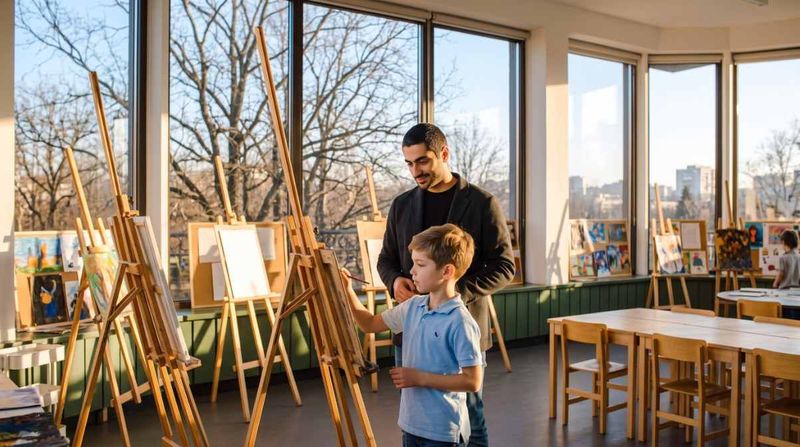
A few things that shift the atmosphere more than any single lesson plan.
Normalize rough first attempts by making them visibly, obviously normal. Do a scrappy sketch on the board yourself. Leave your own mistakes on it. Students take a surprising amount of permission from watching an adult make something bad on purpose.
Stop treating every piece as a final product. If every artwork gets collected, marked, and displayed, students will treat every artwork as a test. Some work should exist only as practice, and they should know that before they start.
Offer real choices. Two or three ways into the same challenge let students pick the entry point that feels manageable without lowering what you are asking of them.
Make "I don't know yet" an acceptable answer. Out loud, more than once, until they believe you.
Be careful about comparison. Holding up one student's work as the standard tells everyone else what the target looks like, and most of them will aim at it instead of at their own idea.
Helping students start without expecting perfection
Small changes in how you phrase a task change what students think is being asked of them.
Instead of "make a perfect drawing," ask for three rough versions. Quantity removes the pressure from any one attempt.
Instead of "draw this correctly," ask them to find their own way to show it.
Instead of "finish the picture," ask them to change one thing and see what happens.
The instruction is doing the same work in each case. It is just no longer implying that there is a correct result waiting to be matched.
Building confidence in students' creative choices
Confidence does not come from praise. If it did, the most complimented children would be the most fearless, and any teacher can tell you they often aren't. Constant praise can actually raise the stakes, because now there is a reputation to protect.
Confidence grows when a student makes a decision, sees it through, and finds out that nothing bad happened. That includes the decisions that don't work. A student who tries something strange, watches it fail, and keeps going has learned something more useful than a student who got it right the first time.
So the useful moments are these: deciding without asking, trying something unfamiliar, carrying on after a mistake, explaining why they made a choice, and seeing that a classmate solved the same problem in a completely different way.
Praise the thinking, not the result.
"That's a beautiful drawing," ends the conversation. It also tells the student that beauty was the point.
Try something closer to "I noticed you changed your original idea halfway through." What made you do that?"
Now the student has to think about their own process, which is the thing you actually want them to practice. It also works on drawings that did not come out well, which is when students need the attention most.
Exercises that make starting easier
These are low stakes on purpose. None of them can really be done wrong, which is the point.
One line, no plan. Every student draws a single random line on the page without thinking. Then they turn it into something. Swapping lines with a partner first makes it better, because nobody gets to plan.
Three possibilities. One prompt, three different solutions, fifteen minutes. Students quickly realize their first idea was not their only idea, which is a useful thing to learn early.
Change one thing. Give them an ordinary object and ask them to alter one feature. A chair with the legs of a bird. A cup that cannot hold liquid.
The deliberate mistake. Ask each student to make one unexpected mark on purpose, then build the artwork around it. Students who are terrified of accidents find this one weirdly freeing, because the accident was scheduled.
Same prompt, different answers. Give the whole class an identical challenge and then look at the results together. Twenty different responses to one instruction makes the argument better than any speech you could give about there being no single right answer.
Does creative block go away with practice?
Partly. Practice builds familiarity, and familiarity makes starting less frightening, because the student has evidence that they have begun and finished things before. Repeated low-pressure work does more for this than occasional big projects.
But no, it doesn't disappear. Professional artists stall. Writers stall. The blank page problem is not a childhood phase that people grow out of, and pretending otherwise sets students up to feel like failures when it happens again at nineteen.
What students can actually learn is how to work through uncertainty. That is a skill with steps: shrink the task, make a bad version, change one variable, and come back later. Those are learnable. Never feeling stuck is not.
Practise the process, not only the technique
Technique matters. It is just not the only thing worth rehearsing.
Most art teaching runs on a loop of copy, finish, and get a grade. The more useful loop is question, explore, try, change, and reflect. Students need real opportunities to practice that second loop, which means some lessons where the answer is genuinely unknown to everyone in the room, including the teacher.
Read More: Mixed Media vs. Traditional Media: Choosing Your Creative Practice
A classroom where there is more than one right answer
This is the part that changes everything else.
If students believe the teacher already has a picture in mind of what the finished work should look like, every open-ended task becomes a guessing game. They are not exploring. They are trying to find your answer.
Making room for more than one answer is practical work: accepting different interpretations of the same prompt, letting students choose their own materials and approaches, asking them to explain their reasoning rather than defend their skill, and treating an unexpected solution as interesting rather than incorrect.
What if the goal isn't to find the answer?
Swap the question. Instead of "What is the right way to do this?" ask, "What possibilities can you find?"
That question does not only belong to art. A child who can sit with an open problem, generate several options, test one, and change direction when it doesn't work is doing something that transfers directly into science, writing, design, and ordinary decision-making. Art class is just an unusually safe place to practice it, because the cost of a failed attempt is a sheet of paper.
From fear of failure to willingness to experiment
You can watch this shift happen over a term, and it moves roughly like this:
"What if I'm wrong?"
then
"What if I try?"
then
"What else could I do?"
then
"What happens if I change it?"
That last question is where creative confidence actually lives. Not in the certainty that the work will be good, but in the curiosity about what it will become.
At the Art Journal Foundation, we don't treat creativity as the ability to produce an attractive artwork. It is closer to a way of thinking: asking questions, testing possibilities, solving problems, and arriving at a response that belongs to you rather than to the example on the board. When children are given permission to question and experiment, the anxiety about getting it right tends to loosen, and something more interesting takes its place.
Conclusion:
A student freezing in art class is usually not a student without ideas. More often they are carrying some mix of fear of failure, perfectionism, worry about being judged, and too many options with no obvious entry point.
Teachers can shift most of that by lowering the stakes of starting, keeping tasks open-ended, and paying attention to choices rather than outcomes. Not by removing every constraint. Constraints often help, and difficulty is part of the work.
The aim is narrower than it sounds. Make students feel safe enough to begin, experiment, change their minds, and try again. This is at the heart of AJF’s philosophy: nurturing minds that feel free to question, explore, experiment, and create, not simply aim for the “right” answer.
The goal of creative education isn't to make every child confident before they begin. It's to give them enough freedom to begin, experiment, and discover that they can.
FAQs
1. Why do some students feel anxious or freeze in art class?
Usually because the task feels like a test with a correct answer. Fear of making a mistake, worry about how the work will be judged, perfectionism and an overwhelming number of choices all make the first mark feel risky. The student is not short of ideas. They are short of a safe way to start.
2. Is this related to perfectionism or fear of judgment?
Often both, and they feed each other. Perfectionism shows up as constant erasing, restarting and asking for reassurance. Fear of judgment shows up as copying classmates, choosing the safest possible idea, and checking whether something is allowed before doing it.
3. What can teachers do to reduce anxiety in art class?
Treat rough first attempts as normal, including your own. Stop marking and displaying everything. Offer two or three ways into the same task. Talk about what students tried rather than comparing finished pieces. Say "I don't know yet" is a fine answer, and mean it.
4. How can students build confidence in their own creative choices?
By making decisions and living with the results. Confidence grows when a student picks something, sees it through, survives a mistake, and can explain why they made the choice. Praise aimed at thinking builds more of this than praise aimed at the finished drawing.
5. Does this kind of creative block go away with more practice?
It gets easier. Familiarity with the process lowers the fear of starting, especially with regular low pressure work. But experienced artists get blocked too. The realistic goal is teaching students how to work through uncertainty rather than expecting it to disappear.
6. How can teachers help students overcome fear of making art?
Shrink the first step until it is too small to fail. One line. One shape. One change to an existing object. Anxiety about a whole artwork rarely survives contact with a task that takes ten seconds.
7. Should teachers focus more on the creative process or the final artwork?
Both have a place, but process deserves more attention than it usually gets. Finished pieces show what a student could already do. The process shows what they are learning to do, and it is the part that transfers outside the art room.