



Eric Cole Nkrumah is a Ghanaian visual artist from Cape Coast, teaching Art & Design (IGCSE/AS/A-LEVEL) at Delhi Private School International, Ghana.
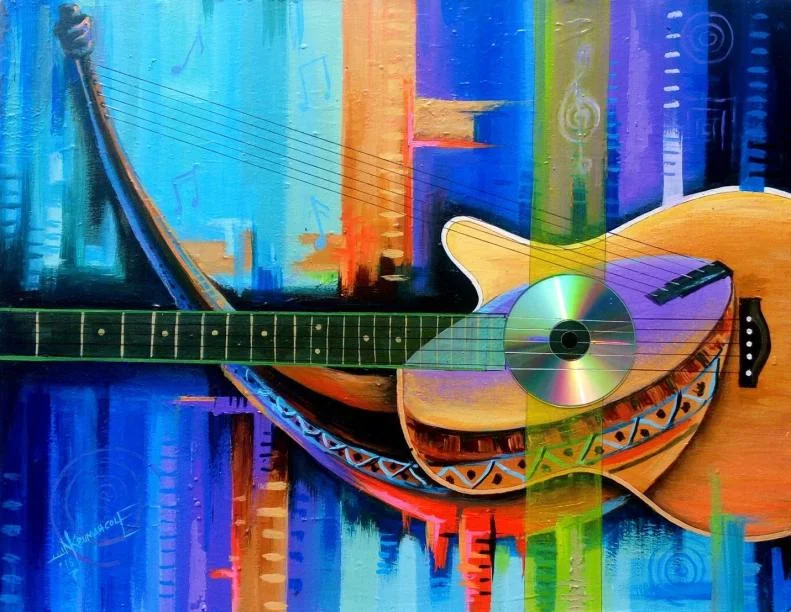
This article repositions Eric Cole Nkrumah’s Afro-Euro musical-instrument paintings within a broader conversation about community, culture, and creativity. Rather than treating cultural fusion as a contest between African and European art traditions, the study argues that Nkrumah’s canvases model a creative practice that builds community by making cultural difference visible and shared. The findings show that Nkrumah’s recurring device — a compact disc rendered as a shared sound-hole across saxophone, seprewa, guitar, and keyboard — argues that creativity is most powerful when it channels several cultural voices into one instrument of communal expression.
Creativity as a Meeting Place
Every community that has made music has, sooner or later, borrowed an instrument, a rhythm, or a scale from its neighbours. European musical culture developed in continuous contact with the oral, symbolic traditions of Africa, just as African popular music absorbed brass, strings, and recording technology from Europe. The relevant question is not which culture supplied more to the other, but how creative people use their work to hold different cultural inheritances together without erasing any of them. This article treats Eric Cole Nkrumah’s paintings of musical instruments as a case study in exactly that kind of creative community-building.
Cultural fusion, read this way, is not a threat to any tradition; it describes how creative communities have always grown. Nkrumah’s paintings, which give African instruments — the seprewa, the balafon, the djembe — and European instruments — the saxophone, the guitar, the piano keyboard — a shared visual language, illustrate that theory concretely.
“Semenhyia” (Acrylic and compact disk on canvas), 90 cm x 120 cm, 2019. Courtesy of the artist.
“Semenhyia,” meaning meeting a necessary helper, centres a saxophone bell whose mechanical keys and spatula anchor the left of the canvas. From its bell erupts a burst of colour resolving, on the right, into two musical notes and a compact disc. Read through a community lens, the painting proposes that technology — symbolised by the disc — does not dilute a culture’s musical voice; it extends that voice’s reach, letting a community’s sound travel to other communities without losing its origin.
“Wonfre Yie,” meaning a call for harmony, abstractly fuses a seprewa (the Akan harp-lute) with an acoustic guitar. The seprewa’s neck, strings, and bridge merge with the guitar’s fretboard and bridge, while a single compact disc serves as both focal point and shared sound-hole. The single sound-hole is the painting’s clearest statement about community: different instruments, different origins, one shared source of resonance.
A Wider Gallery of Fusion
Nkrumah’s “Keys of Life” series extends the same visual grammar across nine further works, pairing keyboards, xylophone-like balafons, saxophones, and guitars with the recurring compact-disc motif. Music across Sub-Saharan Africa relies heavily on percussion — xylophones, djembes, drums, and tone instruments such as the mbira — carried into diasporic genres from calypso to rumba to the blues. Musicians such as Angola’s Victor Gama, who built new instruments and performed with the Kronos Quartet, and Zimbabwe’s Thomas Mapfumo, who challenged guitarists to accommodate the mbira, show that this fusion is already lived practice at community scale.
The same principle travels beyond the Afro-European pairing in Nkrumah’s canvases. Indian instruments such as the Sitar and Tabla have long entered global collaborative recordings alongside guitars, saxophones, and keyboards, in projects that — like Nkrumah’s shared sound-hole — locate one rhythmic centre that different traditions can join without surrendering their timbres. A Seprewa merging with a guitar around one disc is a small, local instance of a worldwide pattern: communities strengthen cultural understanding, and celebrate their differences, by creating shared points of contact rather than shared uniformity.
Conclusion
Reframed around community, culture, and creativity, Nkrumah’s paintings stop being evidence in a contest over which tradition dominates and become a demonstration of how creative practice builds community across cultural lines. The recurring compact disc — sound-hole, focal point, and technological bridge at once — argues that no culture needs to abandon its instruments or symbols to be heard by, or to listen to, another. Art educators and working artists should keep producing works that make these points of contact visible, because creativity of this kind is one of the most durable ways a diverse community keeps talking to itself.