


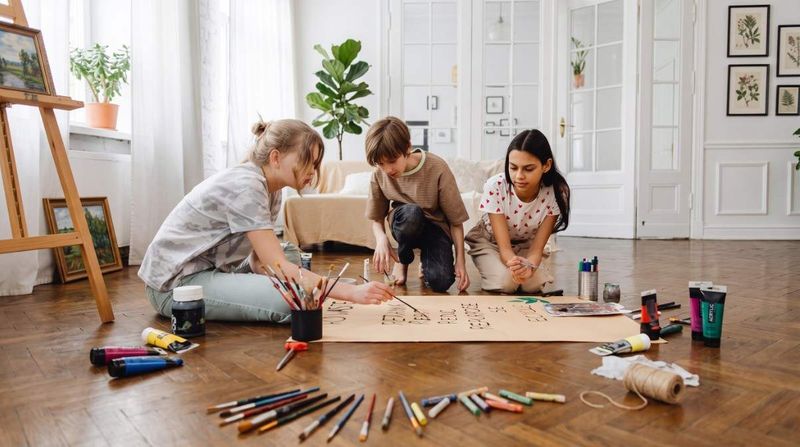
Most art assignments still work the way they always have: one student, one canvas, one grade. That makes sense for a lot of what art class is trying to teach. But it also means students rarely get asked to make something with other people, and that's a strange gap, because almost every job, studio, and creative field they'll eventually work in runs on collaboration.
Group art projects fill that gap in a way worksheets and group discussions can't. When a mural only works if five students agree on a color palette, or a shared sculpture only stands up if everyone's piece fits together, students have to talk, listen, disagree, and figure it out. That's where the real collaborative art projects benefits show up: not in the finished piece, but in the arguments, compromises, and small decisions it took to get there.
This post looks at what actually happens socially when students create together, how teachers can set up a group project so it doesn't turn into one kid doing all the work, and where collaboration fits (and doesn't fit) into IB Visual Arts specifically.
What counts as a collaborative art project?
A collaborative art project is any piece where the outcome depends on more than one person's decisions, not just their hands. That's an important distinction. Ten students painting ten tiles that get bolted together afterward is closer to parallel individual work than true collaboration. A group that has to agree on a theme, divide up sections, and adjust their own work based on what a classmate just painted next to them is doing collaborative creativity in classroom settings for real.
The difference matters because it changes what students practice. Individual art builds technical skill and personal voice. Group art projects for students add a second layer: negotiating a shared creative process with people who don't see the piece the way you do. Both are valuable. They're just not the same skill.
How collaborative art projects build social skills
Put a group of students in front of a blank wall and tell them to fill it, and within a few minutes you'll see the same dynamics that show up in group projects across every subject: someone takes charge, someone goes quiet, someone disagrees with the direction and has to decide whether to say so.
Art doesn't remove that friction. If anything, it raises the stakes a little, because the disagreement is visible and permanent once the paint dries. Students have to listen to ideas they didn't come up with, explain their own choices in a way that doesn't shut other people down, and accept that the finished piece won't look exactly like what they pictured. That's social skills through art in practice, and it's harder to fake than a worksheet answer.
Key social skills students develop through art
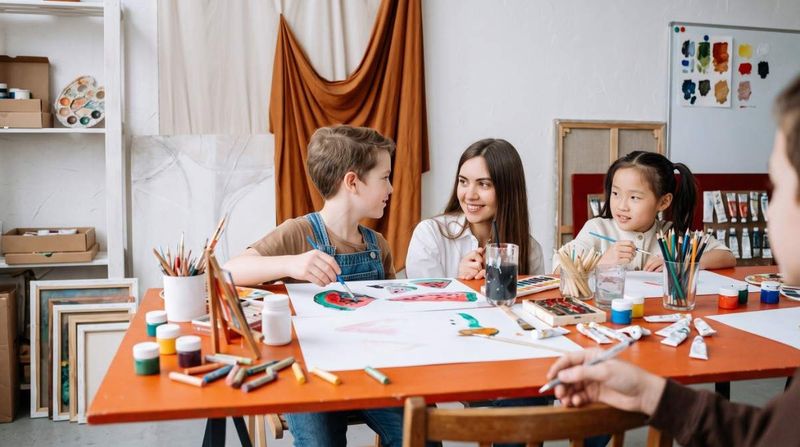
Communication
Explaining a visual idea out loud is harder than it sounds. A student who can sketch something beautifully might struggle to describe why they want a certain color in a certain spot, and that's exactly the kind of practice group art forces.
Listening
Students have to actually take in a classmate's idea instead of waiting for their turn to talk. In a mural or mixed-media piece, missing what someone else is doing means literally painting over it.
Teamwork
A shared piece only works if the group agrees on where it's headed, even loosely. That's different from cooperating on a worksheet; the goal has to stay visible and consistent across everyone's individual contributions.
Empathy
Working next to someone else's creative choices, and having to build on them rather than replace them, teaches students to see value in an approach they wouldn't have picked themselves.
Conflict resolution
Two students who both want the mural's centerpiece to be their idea have to work it out. There's no teacher-assigned tiebreaker for taste. This is communication skills in group art at its most direct.
Confidence
Contributing to something bigger than an individual assignment, and having that contribution actually matter to the final piece, tends to build confidence faster than praise alone does.
How teachers can structure a group art project
Collaborative projects fall apart most often for one of two reasons: no clear goal, or one student doing the thinking for the whole group. A little structure fixes both.
Start with a defined creative goal: A vague prompt like "make something together" invites chaos. A specific theme or constraint, even a loose one, gives the group something to argue productively about instead of arguing about nothing.
Give everyone a role: Not every student needs to be the lead designer. Some can plan composition, others can manage materials, others can focus on a specific section. Roles based on actual strengths keep quieter students from disappearing into the background.
Build in time for idea sharing before anyone touches a brush: A quick round of sketches and short pitches, five minutes each, keeps one loud voice from steering the whole project before anyone else has spoken.
Let students make real decisions: This is the hardest part for a lot of teachers to sit with. If the teacher resolves every disagreement, students never practice resolving one themselves. Some intervention is fine, but the group should own most of the choices.
Reflect together once it's done: A short discussion about what changed from the original plan, what got argued about, and what surprised people turns the project into a team-based art activities exercise with actual takeaways, not just a finished piece on the wall.
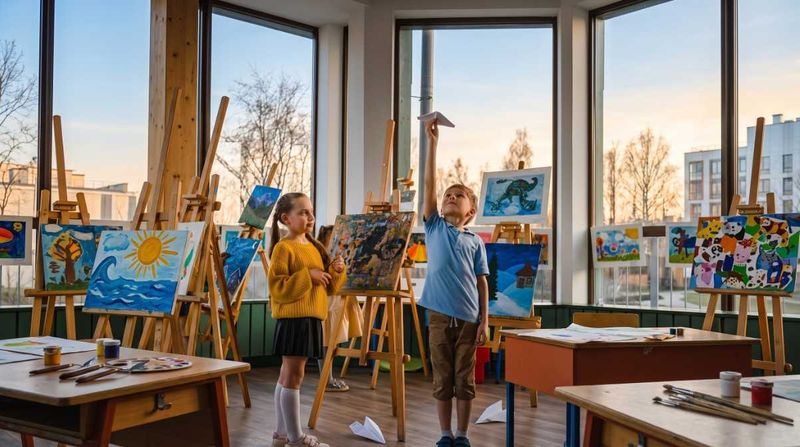
Collaborative art activities for students
A few formats that work at most grade levels:
Collaborative mural: Each student or small group takes a section, working from a shared theme and color palette agreed on ahead of time.
Collective collage: Students create individual pieces that only make sense once arranged together, which forces some planning around scale and composition.
Visual storytelling: A group builds a sequence of images that tells one story, with each student responsible for a chapter that has to connect to the one before it.
Community art installation: Larger and more logistically involved, built around a shared theme tied to the school or neighborhood.
Mixed-media group artwork: Different students bring different materials (paint, fabric, found objects) into one composition, which naturally forces conversation about how the pieces will actually fit together.
Collaboration and individual creativity
There's a worry some art teachers have, understandably, that group work flattens individual style. If everyone has to agree, doesn't the strongest personality just win?
Not necessarily, and this is where a lot of blog posts on this topic stop short. Working alongside other students' ideas can sharpen a student's own voice rather than dilute it. Seeing a classmate solve a composition problem in a way you hadn't considered gives you a new tool, not a replacement for your own instincts. Students who collaborate regularly tend to get more comfortable adapting an idea mid-process instead of abandoning it the moment it doesn't go as planned, which is closer to how working artists and designers actually operate.
This is peer learning through art, and it's one of the clearer benefits of art collaboration that doesn't get enough attention: the group project ends, but the habit of building on someone else's idea sticks around.
Collaborative art and IB visual arts
This is worth addressing directly, because it's the part students and parents ask about most and the part general blog posts tend to gloss over.
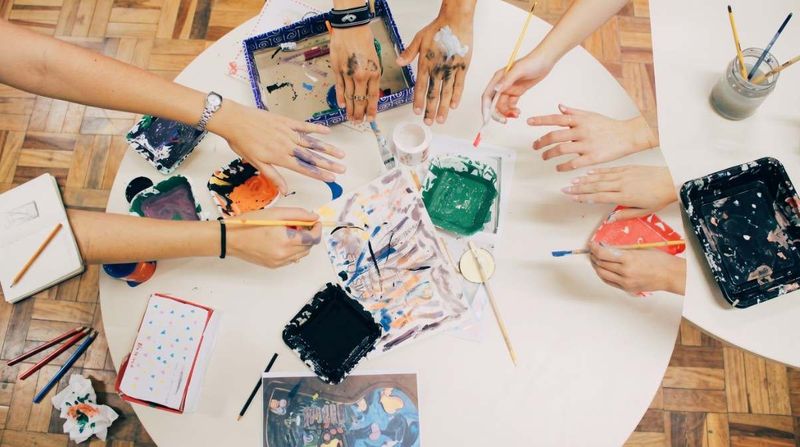
Collaborative work can absolutely support an IB Visual Arts student's development. A group mural or installation can inform research, spark new directions in independent work, and give a student material to reflect on in their process journal. Working alongside peers on a shared piece often reveals techniques or approaches a student later brings into their own practice.
What it can't do is stand in for individual portfolio work without qualification. IB Visual Arts requires students to demonstrate their own artistic development, and a collaborative piece has to be documented in a way that makes clear what that specific student contributed, their individual decisions, their reasoning, their own process, separate from the group's. Students should check the current requirements for their specific programme and talk to their IB coordinator before assuming a group piece counts toward assessed work. Treating collaboration as a shortcut to portfolio content, rather than as a source of ideas and process for it, is the mistake to avoid.
Tips for making group art projects successful
A short list for teachers running one of these for the first time:
- Keep the objective specific enough to argue about, but not so rigid that it removes creative choice.
- Give students real creative freedom within the constraints you set.
- Make sure every student has a role that's visible in the final piece.
- Set an expectation for respectful feedback before the project starts, not after the first disagreement.
- Watch for one student dominating and redirect gently rather than taking over yourself.
- Grade or discuss the process, not just how the final piece turned out.
Conclusion
A collaborative artwork is more than a shared canvas. It's a record of a few dozen small decisions: who spoke up, who compromised, who tried something they wouldn't have tried alone. Students walk away from a good group project having practiced skills that don't show up anywhere on the finished piece itself. The artwork belongs to the group. What each student takes from making it is personal, and that's really the point.
FAQs
1. What social skills do collaborative art projects build?
Mainly communication, listening, teamwork, empathy, conflict resolution, and confidence. These develop through the actual back-and-forth of building something together, not through instruction alone.
2. How should teachers structure a group art project?
Set a clear creative goal, assign roles based on students' strengths, build in time for idea sharing before work begins, let students make real decisions, and reflect together once the project is finished.
3. What are examples of good collaborative art activities?
Collaborative murals, collective collages, visual storytelling projects, community installations, and mixed-media group artwork all work well across most age groups.
4. How does collaboration affect individual creative growth?
It tends to sharpen a student's own instincts rather than replace them, since working alongside other approaches gives students more tools to draw on in their independent work.
5. Can collaborative projects count toward IB portfolio requirements?
Sometimes, but not automatically. Students need to document their own individual contribution and decisions clearly, and should confirm the specific requirements with their IB coordinator before relying on group work for assessed portfolio content.