


Two students get the same assignment.
The first one can draw. Proportions are right, shading is clean, and you can tell she has put in hours. She also erases constantly, starts over twice, and asks you three times whether she is doing it correctly.
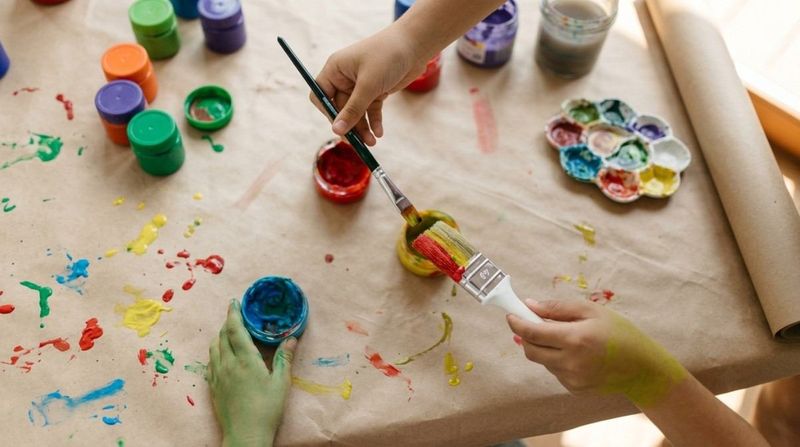
The second one is nowhere near her technically. His hands are a bit of a mess. But he has already tried the idea two different ways, decided he liked the second version better, and is now coloring it in something close to neon green because he felt like it.
Which of them is more creatively confident?
The answer is obvious once you separate the two things. Skill is what you can do. Confidence is whether you are willing to use it, commit to a choice, and find out what happens. They are related, and they often grow together, but not always and not at the same rate. Plenty of people have far more of one than the other.
What is creative skill?
Creative skill is the set of abilities you build through learning and practice. In visual art that covers drawing technique, understanding color, composition, design sense, craftsmanship, handling different tools and materials, and knowing enough about how images work to make something read the way you intended.
It is measurable, at least roughly. You can look at work from a year ago and see the difference.
How creative skills develop
Through practice, mostly. Also through instruction, useful feedback, observation, repetition, and experimenting with things you have not done before. None of that is mysterious. It is closer to learning an instrument than to waiting for inspiration.
Skill is not something you either have or don't
The "not artistic" label gets applied early and sticks hard, usually on the basis of a few drawings made by a seven-year-old. It says almost nothing about what that person could do with instruction and a few hundred hours. Most adults who believe they cannot draw are describing an absence of practice, not an absence of capacity.
What is creative confidence?
Creative confidence is harder to see from the outside, but it shows up in behavior. A creatively confident person is willing to:
- Say an idea out loud before it is fully formed.
- Try something they have never done.
- make a decision without checking whether it was the approved one
- Work on something when success is not guaranteed.
- sit with not knowing how it will turn out
- abandon an idea partway through and take a different route
- Accept that the first attempt might be bad
Notice that none of those require talent. They require a tolerance for uncertainty.
Confidence isn't the same as certainty.
This is where people get confused. Confidence is not the feeling of knowing exactly what you are doing.
A confident creator says, "I'm not sure this will work, but let's find out."
Certainty says, "I know exactly how this goes."
Certainty is often the enemy of interesting work, because it keeps you inside what you have already proved you can do. The willingness to be unsure in public is the actual skill.
Creative confidence vs. creative skill: the key difference
| Creative Skill | Creative confidence |
|---|---|
| What you know how to do | How willing you are to use it |
| Develops through practice | Develops through experience and action |
| Technical ability | Belief that you can explore |
| Shown through technique | Shown through choices and risks taken |
| Does not guarantee experimentation | Makes experimentation likely |
You can have one without the other
Four situations, and every classroom contains all of them.
High skill, high confidence. This student can execute an idea and is willing to push it somewhere unexpected. They are usually not the ones who need help, though they can get bored if the work is too prescribed.
High skill, low confidence. Technically strong, visibly hesitant. Waits for approval before committing. Produces careful, competent work that never quite surprises anyone, including themselves. This combination is more common than people expect, and it is the one that gets overlooked because the work looks fine.
Low skill, high confidence. Throws themselves at everything, makes a mess, and improves quickly because they are getting far more attempts than everyone else. Easy to underestimate. Often the one who catches up.
Low skill, low confidence. Needs both things at once: technical support so the work becomes achievable and low-pressure tasks so attempting it stops feeling dangerous. Giving only one of the two usually doesn't move them.
Can someone be skilled but lack creative confidence?
Yes, and it happens constantly.
The reasons are familiar: fear of making mistakes, comparison with people who are better, perfectionism, criticism that landed badly at some point, expectations from parents or teachers, and a habit of waiting for someone else to say the work is good before believing it.
Sometimes skill makes it worse
This is the part people miss. Getting better does not automatically feel better.
As skill grows, so does the ability to see flaws. A beginner draws a hand and is pleased it looks like a hand. Someone three years in draws the same hand and can see six things wrong with it. Their taste has developed faster than their execution, which is a normal and deeply uncomfortable stage.
The result is that more skilled students are often harder on themselves. They now know what the work should look like, and every gap between the image in their head and the thing on the page registers as failure.
How confidence influences creative risk-taking
The loop works like this: confidence leads to more attempts, more attempts produce more learning, and more learning slowly builds more confidence. It compounds. So does the opposite.
A student who is willing to take creative risks will try unfamiliar techniques, chase an idea that might be silly, show work before it is finished, change direction halfway through, and recover reasonably quickly when something fails. Each of those produces information. A student who avoids risk produces fewer, safer pieces and learns less from them, even if the pieces look better on the wall.
Creative risk is not recklessness
Nobody is asking anyone to ruin their work on purpose. Creative risk just means trying an approach when you do not already know how it will turn out.
Using a color combination you have never used. Drawing without erasing for one session. Starting a piece with no plan. These are small in absolute terms and large in what they ask of an anxious person.
Why highly skilled artists still doubt their work
Comparison
Skill does not protect anyone from this. If anything, it sharpens it, because a skilled artist can see exactly what someone better is doing and exactly how far away it is. Instagram made this considerably worse by ensuring that everyone's feed is full of the best work of thousands of strangers.
Perfectionism
There is always a version in your head. It is always better than the version on the paper. That gap never fully closes, because taste keeps moving too. Learning to work anyway, with the gap still there, is most of the job.
Relying on other people to tell you it's good
If confidence is built on praise, grades, likes, or awards, it lives outside you and can be taken away at any time. A bad critique or a quiet week online then reads as evidence about your worth rather than about one piece of work. Confidence that depends on an audience is not really stable.
Feeling like a fraud
Imposter feelings come up a lot in creative fields, often in people whose work is clearly good. It tends to sound like, "I got lucky; they haven't noticed yet; the last one was a fluke."
It is worth naming because it helps people recognize it, but it is not worth turning into a diagnosis. Doubting your work sometimes is ordinary. It only becomes a problem when it stops you making things.
What mistakes are actually for
Creative work almost never comes out right the first time. That is not a sign of weakness in the process. It is the process.
A failed attempt gives you information you could not have gotten any other way. The composition doesn't work, and now you know why. The colors fight each other, and now you have seen what that looks like rather than been told about it. Experimentation only means anything if failure is genuinely possible; otherwise, it isn't experimentation.
The practical problem in most classrooms is that students rarely get to revise. Work is made once, handed in, marked, and returned. Under those conditions every attempt is final, so of course students play it safe.
When failure becomes feedback
The shift is small, and it changes a lot.
Instead of "this didn't work," ask "what did this attempt teach me?"
One of those sentences ends the work. The other one continues it. Students need to hear the second version from an adult several times before they start saying it to themselves.
How creative confidence develops over time
Confidence is built in a loop, not delivered in a lesson.
- Try: Make the first move, badly if necessary.
- Experiment: Test a few possibilities instead of committing to the first one.
- Reflect: Look at what happened and be specific about which parts worked.
- Adjust: Change the approach based on what you noticed.
- Try again: Repeat until uncertainty starts to feel ordinary rather than threatening.
- Take bigger risks: Slowly expand what counts as a reasonable thing to attempt.
The useful thing about this loop is what it implies. Creative confidence is not a prerequisite for starting. It is a byproduct of having started, repeatedly, and survived. Students who are waiting until they feel ready are waiting for something that only arrives after the thing they are avoiding.
Technical skill vs. self-expression
Technique lets you execute an idea. It does not supply the idea, and it does not decide whether the idea was worth having.
Self-expression is the other half: making choices, communicating a point of view, developing something recognizable as yours, deciding what you actually care about, and interpreting a subject rather than reproducing it.
The technique should serve the idea
A lot of art education measures only the first half, because it is easier to assess. Accuracy can be marked. Intention is harder.
The cost of that is students who can render a still life beautifully and have never been asked what they wanted to say. They finish school technically competent and creatively silent and then wonder why making work feels hollow. Technique is worth teaching properly. It just shouldn't be the only thing that counts as success.
How teachers can build creative confidence in students
Give real choices. Two or three legitimate routes into the same prompt let students commit to a decision that is theirs, which is where confidence actually comes from.
Make experimentation safe by making some work clearly ungraded and saying so before it starts. If everything is assessed, nothing is exploratory.
Ask about decisions instead of only completion. "Is it finished?" invites a yes or no. "Why did you choose this approach?" asks the student to own a choice, and it works equally well on strong and weak pieces.
Avoid comparing outcomes. Holding one piece up as the standard tells the room what the target is, and most students will aim at it rather than at their own idea.
Value revision. Let students rework, rethink, and resubmit. A student who has improved a piece three times has learned something a first draft could not teach them and has also learned that a bad first version is not fatal.
Practical ways to strengthen creative self-belief
For students, teachers, and anyone who makes things:
- Start smaller than feels serious. A ten-minute challenge beats a project you never begin.
- Make three versions instead of one good one. It removes the pressure from any single attempt.
- Keep an idea journal, including the bad ideas. Especially the bad ideas.
- Try methods you are not good at, on purpose, where nobody is watching.
- After something fails, write down one thing it taught you. One sentence is enough.
- Show work before it feels ready. This is uncomfortable, and it works.
- Track progress against your own older work, not against other people's current work.
- Keep "this piece didn't come out well" separate from "I am not good at this." They are different claims, and only one of them is supported by evidence.
Why creative confidence matters beyond art
Very few students will become professional artists. Almost all of them will face problems with no obvious answer, and that is the same skill in different clothes.
The habit of generating several options instead of one, committing to an approach without certainty, noticing when it isn't working, and changing direction without treating that as failure transfers directly into problem solving, decision-making, collaboration, and any job where the instructions run out before the work does.
At the Art Journal Foundation, we treat creativity as broader than artistic ability. It is a way of thinking: asking questions, testing possibilities, solving problems, and imagining what could exist that doesn't yet.
Creative skill gives you the ability to make something. Creative confidence gives you the willingness to ask what else you could try. The second one is the part that keeps working long after the drawing lessons stop.
Conclusion
Skill answers the question, "Can I do this?"
Confidence asks the different question, "Am I willing to try?"
Neither one substitutes for the other. A confident person with no technique gets frustrated by the gap between intention and result. A skilled person with no confidence makes careful work that never goes anywhere interesting.
Skills need practice. Confidence needs experience, which means attempts, which means accepting that some of them will not work. Both grow the same way, and neither requires anything close to perfection to get started.
Creative confidence doesn't mean believing every idea will work. It means trusting yourself enough to explore what happens when you try.
Have questions about creative learning or want to explore how AJF can support your creative journey? Contact us to learn more.
FAQs
1. What's the actual difference between creative confidence and creative skill?
Skill is the technical ability you build through practice: drawing, color, composition, and handling materials. Confidence is your willingness to use that ability, make a decision, and try something without knowing how it will turn out. One is capability, the other is behavior.
2. How does confidence affect the willingness to take creative risks?
Directly. Confidence produces more attempts, more attempts produce more learning, and that learning feeds back into confidence. Students who avoid risk make fewer and safer pieces, so they learn less even when the results look tidier.
3. What helps build creative confidence over time?
Repetition of a loop: try, experiment, reflect, adjust, try again. Small low-pressure challenges, multiple versions instead of one, and regular chances to revise all speed it up. Confidence follows action rather than arriving before it.
4. Why do some highly skilled artists still doubt their own work?
Because taste usually develops faster than execution. The better you get, the more clearly you can see the gap between what you imagined and what you made. Comparison and reliance on outside approval make it worse.
5. How can teachers build confidence in beginner artists?
Shrink the first step until failing at it is impossible, and make it clear that early attempts are meant to be rough. Beginners need evidence that starting badly is normal, which is easiest to provide by demonstrating it yourself.